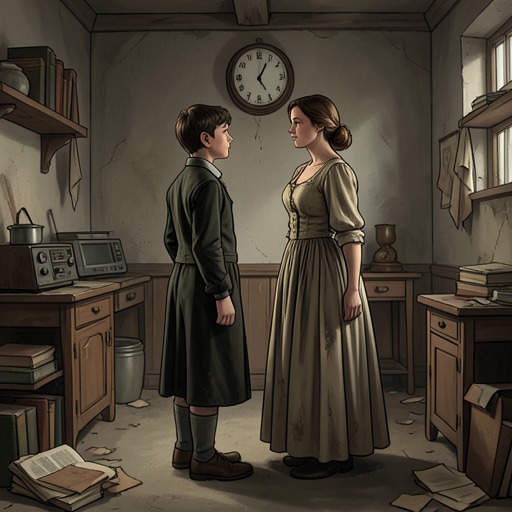
Pip and Miss Havisham
Great ExpectationsPip and Miss Havisham are connected by a relationship that begins as a calculated use of a village boy for diversion and becomes, in Pip’s imagination, a promise that he will win Estella. Miss Havisham’s repeated instructions to love Estella help sustain that belief, while her later recognition of her wrongdoing comes only after Pip has suffered from it. Their eventual exchange turns a relationship shaped by power and misinterpretation toward candor, forgiveness, and a final act of care.
First Visits and the Making of a Role
When Pip is first sent to Satis House, Miss Havisham is already known in the surrounding district as immensely rich, grim, secluded, and protected by a barricaded house. His sister makes clear that he is expected to go and play there, or else be made to work. Miss Havisham herself says she wants diversion and has done with other company. The difference in their positions is plain: Pip arrives as a boy summoned to serve her purpose, while she controls when he plays, what he sees, and when he may return.
Miss Havisham calls Estella to her and tries a jewel against the young woman’s hair and bosom, saying it will be hers one day. She then directs Estella to play cards with Pip. The game ends with Estella winning everything and throwing the cards down as though they were contemptible for having been won from him. Miss Havisham watches the contest, draws Pip’s attention to Estella’s beauty, and later has the pair play again. The repeated arrangement makes Pip’s humiliation part of the diversion: Miss Havisham does not simply introduce him to Estella but frames their encounters so that he is made conscious of the distance between them.
Her manner also makes the visits feel less like an ordinary invitation than a private ritual. She declares that she knows nothing of days or weeks and tells Pip to return after six days. At another visit, when he is reluctant to play, she asks whether he is willing to work instead. The recurring choice is not really an invitation to speak freely; it keeps him within the terms she has set. Estella is told to take him downstairs, give him something to eat, and let him look about while he eats, after which Pip leaves the house and walks the four miles home.
The Effect on Pip
The early visits change the way Pip sees himself. Leaving Satis House, he dwells on being a common labouring boy, his coarse hands and thick boots, his ignorance, and even his habit of calling knaves Jacks. His shame is not simply a response to Estella’s treatment: Miss Havisham has arranged a scene in which Estella’s refinement and beauty are repeatedly set before him, and his own ordinary life becomes newly humiliating by contrast. Looking back, Pip calls the day that began this transformation memorable, a first link in a chain that might be made of iron or gold, thorns or flowers.
The atmosphere of the house reinforces the unequal terms of the relationship. On one visit, a neglected garden holds ruined cabbage-stalks and a misshapen box tree; a patch of snow remains in its cold shadow. Pip’s attention to this abandoned corner belongs to his experience of a place where the past has not yielded to ordinary time. Miss Havisham’s own declarations that she is tired, wants diversion, and has no sense of the calendar help make her control of the visits seem part of that arrested household world. The boy is brought into it for her use, then sent back outside with a changed sense of his position.
As an adult narrator, Pip does not settle the question of how much responsibility for his altered state belongs to Miss Havisham, his sister, or himself. He says that the change was made, and that it is no longer possible to undo it by allocating blame. This retrospective qualification matters: he can identify the damage done by the visits without treating the relationship as a simple account of one person’s influence. His later understanding of Miss Havisham’s role grows out of his own admission that he was changed, and out of his recognition that he had also sustained a mistaken interpretation.
An Assumed Promise
Years later, Pip returns to Miss Havisham’s room by a familiar route and knocks in his old way. She recognizes the knock as his before he enters. When they come back into the house, he learns that his guardian, Mr. Jaggers, has visited on business; Miss Havisham is waiting in her chair. She draws Pip close and asks how Estella treats him, then urges him repeatedly to love her. She says she adopted Estella, brought her up, and educated her in order that she be loved. The command turns the earlier card-playing visits into something Pip takes as a direction for his own future.
That night, Pip repeats Miss Havisham’s words to himself and imagines that Estella may be destined for him. He feels gratitude at the prospect, despite his fear that Estella is not grateful for it, and wonders when she will become interested in him. Yet the conviction is not supported by a promise from Estella or by any clear assurance from Miss Havisham that Pip is to marry her. Miss Havisham’s insistence gives Pip a powerful cue, but his hope exceeds what she has actually said. The resulting attachment lasts even as he understands that it works against his peace and happiness.
Pip later states that he loved Estella because he found her irresistible, not because he had mistaken her for an ideal of perfection. He knew his love opposed reason and hope, but that knowledge did not restrain it. This distinction helps clarify Miss Havisham’s influence: she provides the setting and the repeated encouragement that shape his expectation, but the feeling that persists is Pip’s own, sustained despite his growing awareness that it is unlikely to be returned.
Recognition and Confrontation
When Pip finally faces Miss Havisham directly about his mistaken belief, he asks whether she led him on after he had fallen into it. He describes his original place at Satis House as that of a chance boy summoned to gratify a want or whim, and suggests that, by humouring his mistake, she also used him to punish her self-seeking relatives. He does not approach her only to accuse her. He says he was paid for his attendance by being apprenticed, and asks whether she will provide money to secure a lasting, secret benefit for his friend Herbert.
The request for Herbert’s benefit makes the encounter more complex than a demand for personal compensation. Pip admits that he wants something, but directs Miss Havisham’s resources toward another person’s future, without Herbert’s knowledge. In the same meeting, he tells Estella that he has loved her for a long time. Miss Havisham watches them, holding a hand to her heart. When Pip leaves, Estella looks at him with wonder, while Miss Havisham’s expression appears to him to hold pity and remorse. His declaration does not bring him the response he wants, but it makes the emotional consequences of the old household arrangement visible to the person who helped create it.
Miss Havisham later says that she wants to return to the subject Pip raised and show that she is not entirely without feeling. When discussing the money needed to complete Herbert’s purchase, she writes a direct statement intended to clear Pip of suspicion that he has profited from the funds, then gives him the tablets and the pencil chain. Pip tells her that, despite the mistakes between them and his own thankless life, he wants forgiveness and guidance too much to remain bitter. He also urges her to do what she can to restore the part of Estella’s nature that she had withheld from her. His response recognizes Miss Havisham’s responsibility without reducing her to it.
Care, Consequence, and Meaning
Pip’s forgiveness is not a claim that the harm has been erased. He says Miss Havisham may dismiss him from her mind and conscience, but insists that Estella is a different matter and that repairing what can still be repaired is more important than endlessly mourning the past. The distinction marks a change in their relationship: he no longer seeks from Miss Havisham the assurance that Estella is meant for him. Instead, he asks her to acknowledge the effects of her choices and to act for Estella’s sake.
Soon after that conversation, Pip sees a great flame spring up in the room where Miss Havisham has been left, and finds her running toward him with her clothing alight. He stays with her until help arrives, holding her despite his fear that the fire may break out again; only when assistance comes does he realize that both his hands have been burned. The scene makes his care concrete. The boy once summoned as a source of amusement has become the person who remains with Miss Havisham when she is in danger, even though her earlier influence helped create his unhappiness.
Their relationship is therefore not a romance or a simple reconciliation between equals. Miss Havisham controls the first encounters, encourages Pip’s attachment to Estella, and later recognizes the pain and error associated with her designs. Pip, in turn, moves from shame and hopeful misinterpretation to candor about what she did and what he wants. His requests on behalf of Herbert and Estella, his offer of forgiveness, and his immediate care for Miss Havisham show a growing moral independence from the expectations she helped form. The relationship’s significance lies in that reversal: her influence shapes his painful illusion, but it does not finally determine the terms on which he responds to her.